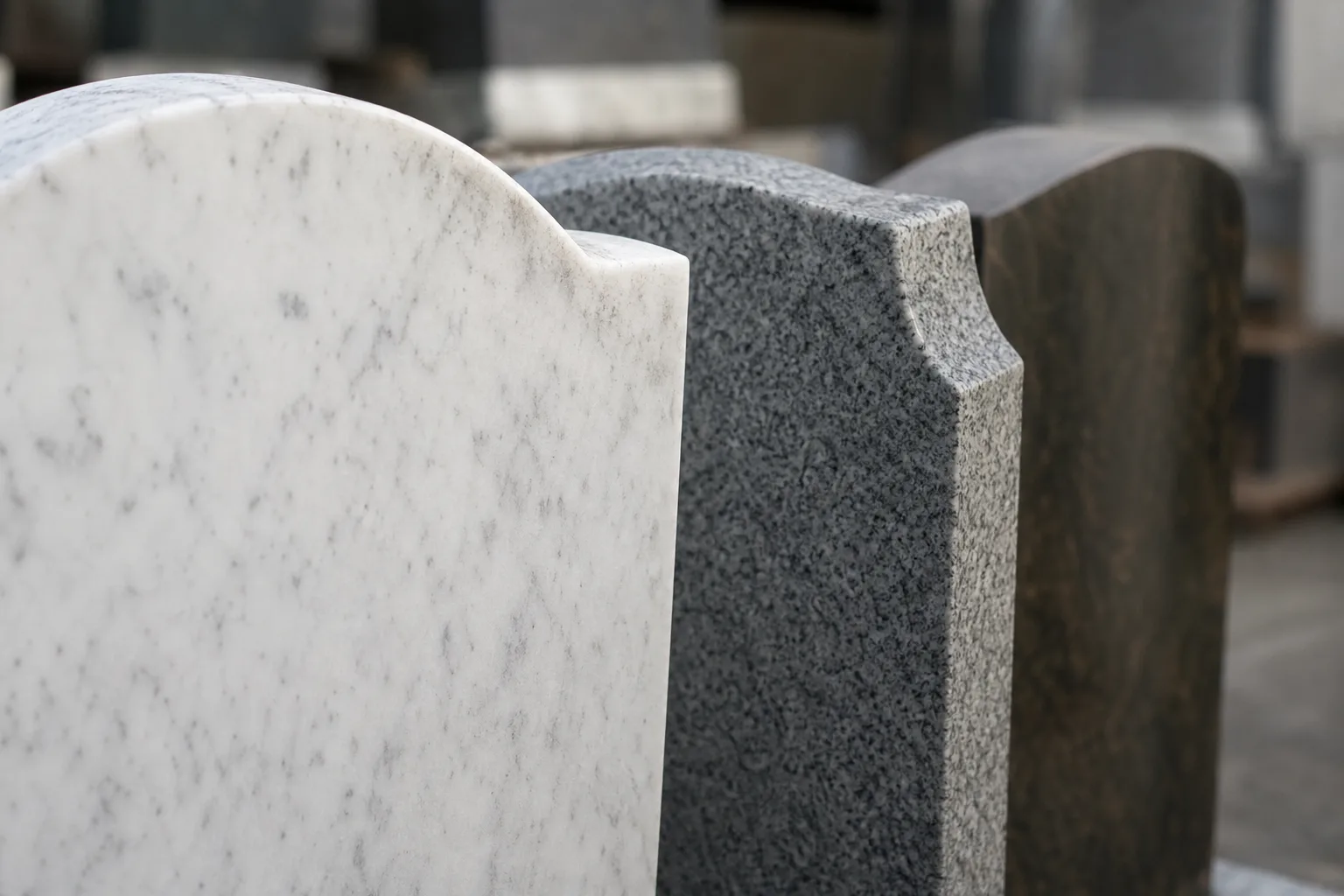
How the three common memorial materials age in open weather, which lettering methods stay readable, and why flat markers outlast upright ones around maintenance equipment.
A memorial is bought once and read for eighty years, which makes it an unusual purchase: the thing you are paying for is legibility in the year 2090, not the appearance of the sample in the showroom. Most families choose by color and price, both of which are visible on the day, and neither of which predicts how the inscription will look after four decades of freeze, thaw, sprinkler spray, and a mower deck passing within inches of the edge every ten days in growing season. The material decides some of that. The lettering method and the setting decide the rest.
1. Marble looks best on day one and loses ground slowly
Marble is calcite, and calcite dissolves in mildly acidic water, which is what ordinary rain has been in much of the country for a long time. The Environmental Protection Agency is the federal body responsible for tracking acid deposition and its effects on building stone, and the mechanism it describes is the same one visible in any old burial ground: crisp Victorian lettering that has softened into shallow shadows, surfaces that have gone from polished to grainy, a texture masons call sugaring. Marble also holds organic growth. In shade, under trees, it darkens and streaks in ways that scrub off only partially and only with care.
2. Granite's grain and color decide how long the letters show
Granite resists the weather that takes marble apart, but weathering is not the only threat to legibility. Contrast is. A sandblasted inscription reads because the frosted letter face reflects light differently from the polished field around it, and that difference is much stronger on black or dark gray granite than on a light speckled pink or gray where the natural grain competes with the lettering. A careful reader asks to see a finished stone in the same color outdoors, at a distance of ten feet, rather than a hand sample held under a shop light.
3. Bronze fails by staining, not by erosion
Cast bronze letters and plaques hold their shape essentially forever, since the letters are formed in the mold rather than cut into a surface. What changes is the finish. Bronze oxidizes to a dark brown or green patina, and rain carries that oxide down onto whatever sits beneath it, which is usually a granite base. Light granite under an untreated bronze plaque will develop a green-brown wash that is difficult to remove without damaging the polish. Cemeteries that run bronze sections often clean and wax the plaques on a schedule, and it is worth asking whether that service exists, how often it runs, and whether the family or the cemetery pays for it.
4. Lettering method matters more than most people are told
Depth is the variable. Deep sandblasted lettering, cut through a rubber stencil in several passes, keeps a shadow long after any applied paint has gone. Laser etching, which burns a fine image into polished black granite, produces remarkable portraits and remarkably shallow marks: beautiful at ten years, thin at fifty, and vulnerable to any surface loss. Lithichrome paint filling the letters is a finish, not a permanence, and it will need renewing at intervals nobody schedules. Hand-cut V incising, still done on better work, is the deepest and the most expensive. Ask which method is quoted, and ask how deep.
5. Flat markers survive maintenance equipment; uprights get hit
Groundskeeping is the single most predictable force acting on a memorial, and flat markers are designed around it. Set flush or slightly below the sod line, a flat bronze or granite marker lets a mower pass straight over the top with nothing to strike, and the string trimmer that chews the base of every upright stone never comes near it. Uprights take that abuse at the exact height where the die meets the base, which is why older upright sections show chipped corners, scarred bottom edges, and paint transfer from equipment. Level setting on a proper foundation is what keeps a flat marker from settling into a bowl that collects water and clippings.
The practical version of all this is a short list of questions for the dealer and a second, separate list for the cemetery office: material and color, lettering method and depth, foundation specification, and who is responsible for cleaning bronze. Answers given before a deposit are answers you can hold someone to.